Wellness Origin Hub
How to read a nutrition label in two minutes
How to read a nutrition label quickly: check the serving size, compare per 100 g, then look at sugar, salt, saturated fat and fibre, with the NHS traffic light thresholds and the FDA's 5/20 rule.
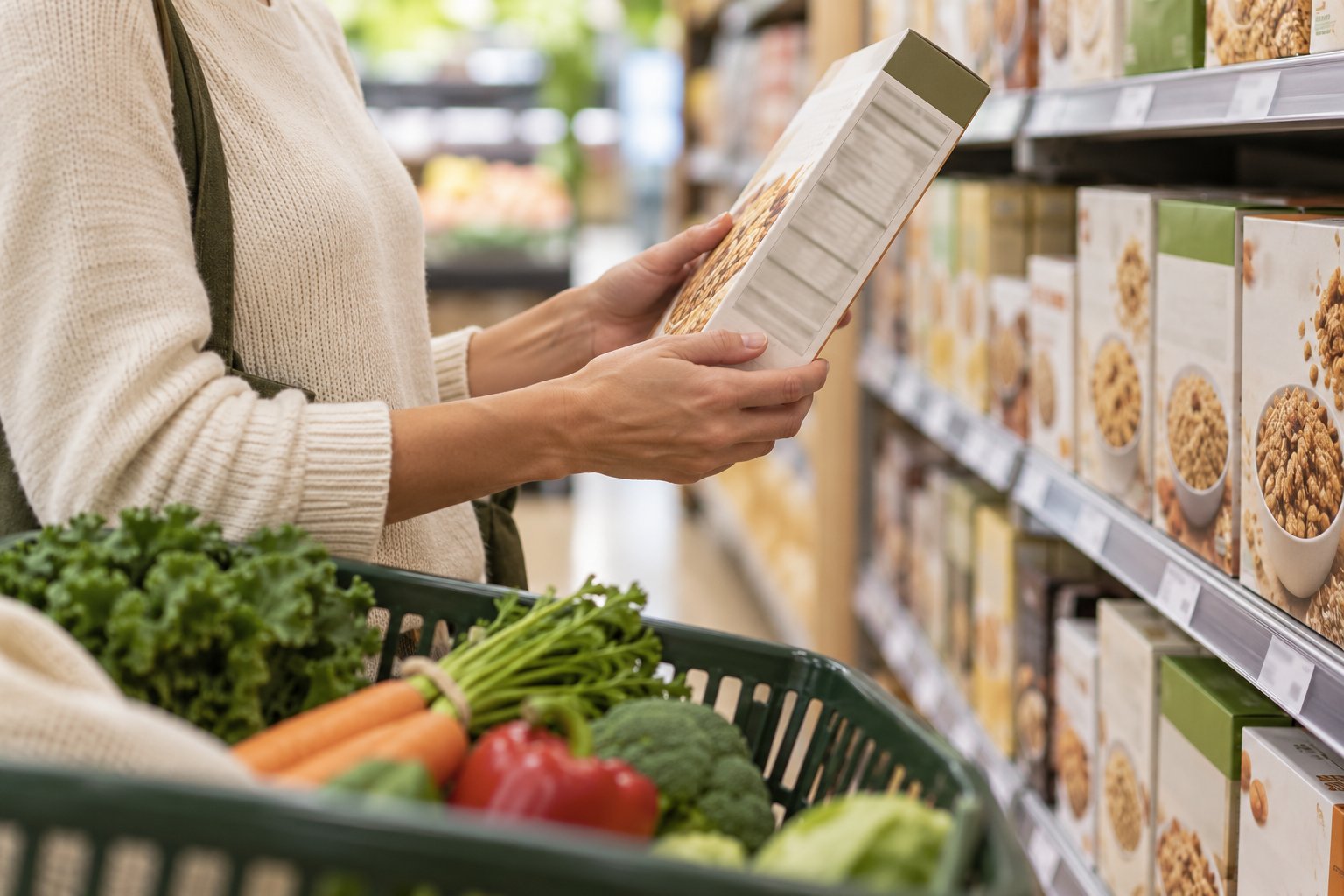
To read a nutrition label quickly, check four things in order: the serving size, the per 100 g column (so you can compare products fairly), the sugar and salt, and the fibre. Then glance at the ingredients list, which is in order of weight. With practice that takes under two minutes, and it is most useful for comparing two similar products side by side.
Step 1: Check the serving size
Every per-portion figure depends on a portion size chosen by the manufacturer, and it is often smaller than what people really eat. A cereal label might be based on 30 g when a filled bowl is closer to 50 g. A bag of crisps or a bottle of drink may contain more than one serving.
Before you read anything else, ask: is that how much I will eat? If you will eat double, double the numbers.
Step 2: Compare per 100 g
Labels in the UK and EU show values per 100 g (or 100 ml) as well as per portion. Use the per 100 g column when comparing two products, because portion sizes differ between brands.
In the US, the Nutrition Facts panel shows values per serving and as a % Daily Value. The FDA suggests a simple rule of thumb: 5% Daily Value or less is low, and 20% or more is high. Aim for lower percentages of saturated fat, sodium and added sugars, and higher percentages of fibre, calcium, iron and potassium.
Step 3: Read the traffic lights (UK)
Many UK packs carry a front-of-pack label coloured green, amber or red for fat, saturated fat, sugars and salt. The NHS sets these thresholds for food, per 100 g:
| Nutrient | Low (green) | High (red) |
|---|---|---|
| Fat | 3 g or less | More than 17.5 g |
| Saturated fat | 1.5 g or less | More than 5 g |
| Sugars | 5 g or less | More than 22.5 g |
| Salt | 0.3 g or less | More than 1.5 g |
Anything between the two is amber. Drinks have lower thresholds, because people tend to drink larger amounts. A product with mostly greens and ambers is generally the healthier choice of two similar items, but the colours are a guide, not a verdict: olive oil, nuts and cheese all score red for fat and still have a place in a balanced diet.
Step 4: Sugar, salt and fibre
Sugar. The "of which sugars" line on UK labels includes sugar naturally present in fruit and milk as well as added sugar. The ingredients list tells you which you are dealing with. US labels show "Added sugars" separately, which makes this easier. The NHS advises adults to have no more than 30 g of free sugars a day. Our guide to sugar in drinks shows how quickly that adds up.
Salt. UK labels list salt; US labels list sodium. To convert, multiply sodium by 2.5: 1 g of sodium is about 2.5 g of salt. The NHS advises adults to have no more than 6 g of salt a day. Bread, cereals and sauces are where it most often hides; our guide to salt and sodium goes through the main sources.
Fibre. Fibre is not always listed on UK labels, but when it is, higher is better. The NHS recommends 30 g a day for adults. A food with 6 g or more of fibre per 100 g can be labelled "high fibre" in the UK. Our fibre guide covers where to find it.
Step 5: Glance at the ingredients
Ingredients are listed in order of weight, largest first. Two things to look for:
- What comes first. If sugar or a refined flour is the first ingredient of a "wholegrain" cereal, that tells you a lot. Our guide to whole grains explains which words to look for.
- Sugar under other names. Glucose syrup, fructose, dextrose, honey, maltose, invert sugar syrup and fruit juice concentrate are all sugars. Several of them spread through a list can add up to a lot of sugar, even when none appears first.
Reference intakes
UK and EU labels often show a percentage of the "reference intake" (RI). These are based on an average adult:
| Nutrient | Reference intake per day |
|---|---|
| Energy | 8,400 kJ / 2,000 kcal |
| Fat | 70 g |
| Saturated fat | 20 g |
| Carbohydrate | 260 g |
| Total sugars | 90 g |
| Protein | 50 g |
| Salt | 6 g |
The sugars figure of 90 g is for total sugars, including those in fruit and milk. It is not a target for added sugar, which should be much lower.
Claims on the front of the pack
Words like "light", "reduced sugar" and "high protein" have legal definitions in the UK and EU, but they compare a product with a standard version, not with a healthy one. "Reduced fat" crisps can still be high in fat. "Natural" and "wholesome" have no fixed meaning at all. The nutrition panel on the back is more reliable than the claims on the front.
Questions people ask
Should I count calories from labels?
You do not need to. Calories are useful for comparing similar products, but looking at sugar, salt, saturated fat and fibre, and choosing more whole foods without labels at all, tends to matter more for most people.
Why do some labels show "kJ" and "kcal"?
Both measure energy. Kilojoules (kJ) are the metric unit and kilocalories (kcal) are what most people call calories. One kcal is about 4.2 kJ.
Photograph: AI-generated image