Wellness Origin Hub
A core workout for beginners that is not just crunches
A 15-minute core workout for beginners built on the dead bug, bird dog, plank, side plank and glute bridge, with sets, timings and easier and harder versions.
A good core workout for beginners trains the trunk to stay steady while the arms and legs move, which is what the core does all day when you carry shopping, lift a child or turn to reverse the car. Crunches only train one direction of that. The routine below uses five moves that resist movement instead: the dead bug, bird dog, plank, side plank and glute bridge. It takes about fifteen minutes and works well two or three times a week.
You need a mat or a carpeted floor. If you are choosing one, see our guide to yoga mats for home.
Why not just crunches?
Your core is more than the six-pack muscle at the front. It includes the deep muscles that wrap around the trunk, the muscles along the spine, the obliques at the sides, the hips and the pelvic floor. Their main job is to keep the spine steady while force passes between the legs and arms.
Moves that ask you to hold a position while something else moves train that job directly, and they tend to be kinder to the neck and lower back than repeated sit-ups.
The workout at a glance
| Move | Sets | Reps or time | Rest |
|---|---|---|---|
| Dead bug | 2 | 6–8 each side | 30 seconds |
| Bird dog | 2 | 6–8 each side | 30 seconds |
| Forearm plank | 2 | 20–30 seconds | 30 seconds |
| Side plank | 2 | 15–20 seconds each side | 30 seconds |
| Glute bridge | 2 | 10–12 | 30 seconds |
Do all the sets of one move before going to the next. Warm up first with a minute of marching on the spot and a few slow cat-cow stretches on all fours.
The moves
1. Dead bug: 2 × 6–8 each side
- Lie on your back with arms pointing to the ceiling and knees bent at 90 degrees above the hips.
- Gently press the lower back towards the floor and breathe out.
- Slowly lower the right arm behind your head and the left leg towards the floor, stopping before your back arches.
- Return to the start and switch sides.
- Easier: move only the legs, keeping the arms still, or tap the heel to the floor with the knee bent.
- Harder: move more slowly, taking four seconds each way, or hold a light weight in your hands.
2. Bird dog: 2 × 6–8 each side
- Kneel on all fours, hands under shoulders and knees under hips.
- Reach the right arm forward and the left leg back until both are level with your body.
- Hold for two seconds without letting the hips tip, then return and switch.
- Easier: move only one leg at a time, keeping both hands down.
- Harder: after reaching out, draw the elbow and knee in under the body before extending again.
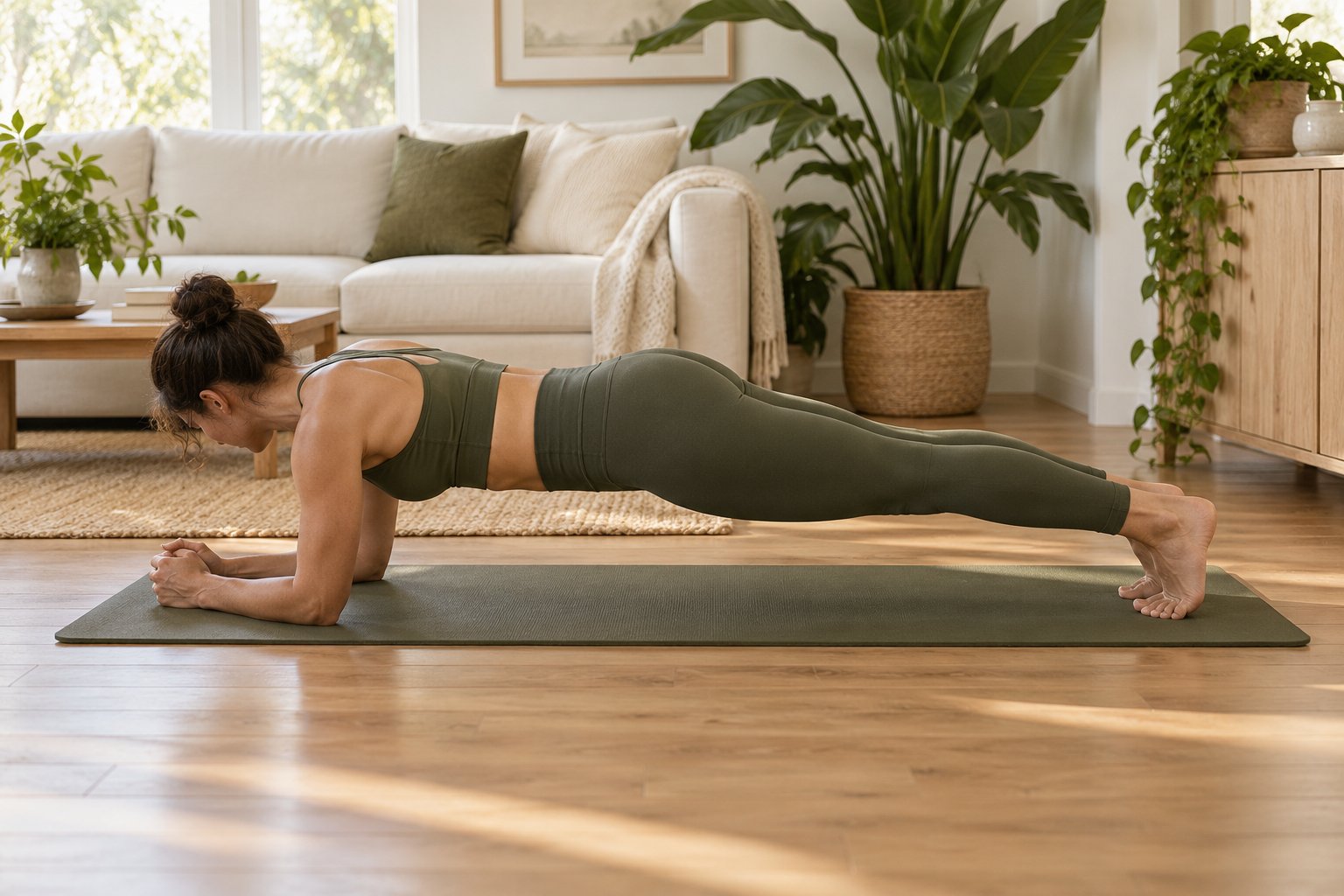
3. Forearm plank: 2 × 20–30 seconds
- Forearms on the floor, elbows under the shoulders, legs straight behind you.
- Squeeze your bottom and brace the stomach as if about to cough.
- Keep a straight line from head to heels and breathe steadily.
- Easier: knees on the floor, or forearms on a sofa seat.
- Harder: lift one foot a few centimetres for a few seconds at a time, alternating.
4. Side plank: 2 × 15–20 seconds each side
- Lie on your side with your elbow under your shoulder and legs stacked.
- Lift your hips so your body forms a straight line from head to feet.
- Hold, keeping the top hip from rolling forward, then switch sides.
- Easier: bend the knees and lift from the knees instead of the feet.
- Harder: raise the top leg slightly, or hold for longer.
5. Glute bridge: 2 × 10–12
- Lie on your back, knees bent and feet flat, hip-width apart.
- Squeeze your bottom and lift your hips until there is a line from shoulders to knees.
- Pause for a second, then lower slowly.
- Easier: a smaller lift, only halfway up.
- Harder: single-leg bridge, 6–8 reps each side.
How to progress
- Weeks 1–2: two sets of each, twice a week.
- Weeks 3–4: add five seconds to each hold, or two reps to each move.
- Weeks 5 onwards: three sets, or move to the harder versions one at a time.
This routine pairs well with a full-body session. Add it after our bodyweight workout or strength training plan, or do it on its own on a lighter day. If you sit for long hours, follow it with a few desk stretches.
Questions people ask
Will this give me a flat stomach?
Core exercises strengthen the muscles but do not burn fat from that area specifically. How the stomach looks depends mostly on overall body fat, which comes down to food, activity and sleep over time.
How long should I be able to hold a plank?
There is no need for very long holds. Thirty to sixty seconds of a well-held plank is plenty for most people; after that, harder variations are more useful than extra time.
Is this good for back pain?
Many people with ordinary stiff backs find gentle core work helpful, but back pain has many causes. Get advice from a doctor or physiotherapist if pain is new, severe or lasting.
Photograph: AI-generated image