Wellness Origin Hub
Ten-minute stretches for desk workers
Ten minutes of stretches for desk workers who sit all day: eight simple moves for the neck, upper back, chest, hips and legs, most of them done at your desk.
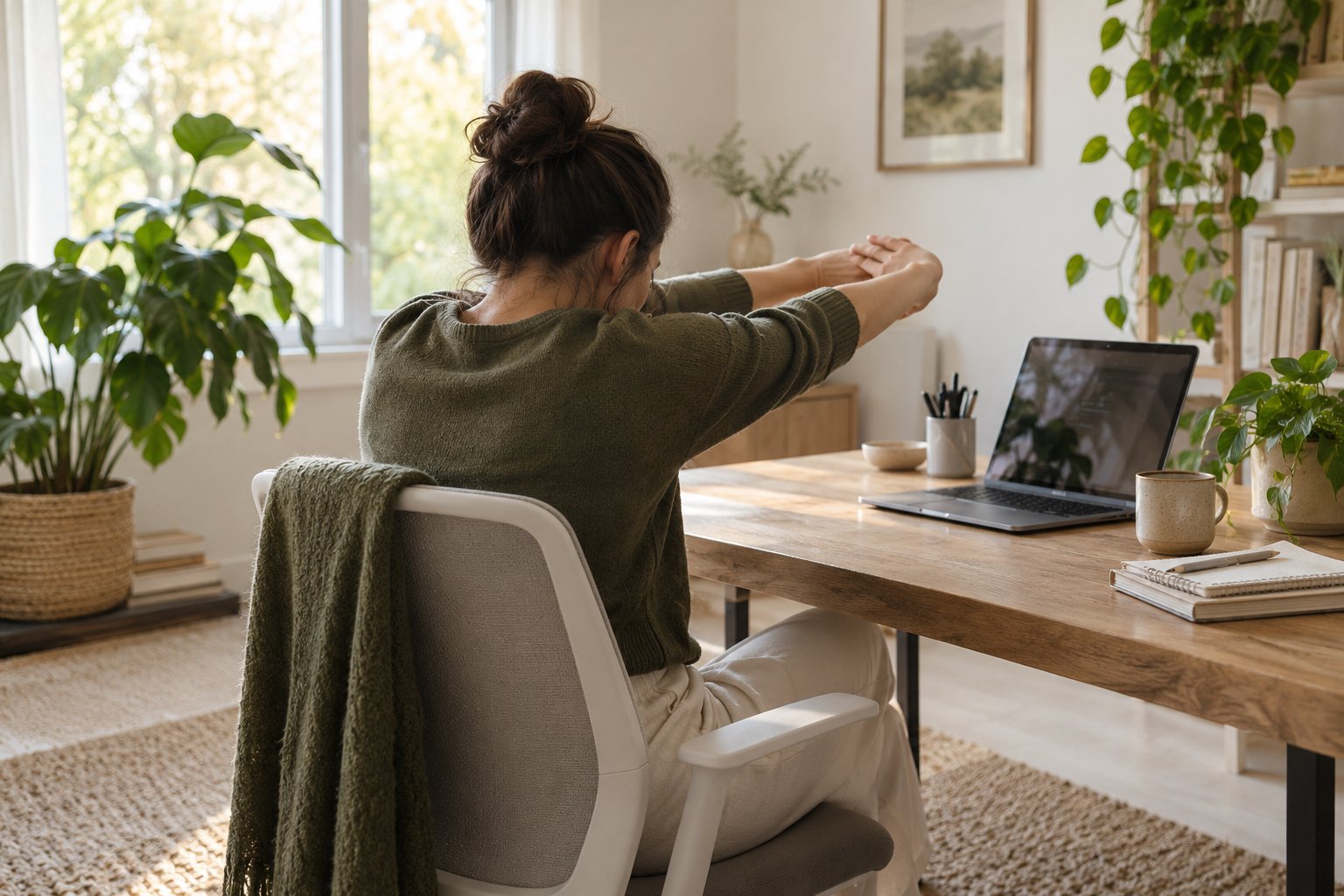
If you sit at a desk all day, ten minutes of gentle stretching can ease the stiffness that builds up in the neck, upper back, chest and hips. The routine below has eight moves, needs no equipment and can be done in work clothes, most of it without leaving your chair. Do it once a day, or split it into two five-minute breaks.
Stretching is only half of the answer, though. The single most useful habit for desk workers is getting up and moving regularly, so treat this routine as a reset, not a licence to sit for another four hours.
The routine at a glance
| Stretch | Where | Time |
|---|---|---|
| 1. Neck side bend | Seated | 30 seconds each side |
| 2. Chin tuck | Seated | 10 slow reps |
| 3. Seated upper back reach | Seated | 3 × 20 seconds |
| 4. Seated twist | Seated | 30 seconds each side |
| 5. Doorway chest stretch | Standing | 30 seconds each side |
| 6. Standing hip flexor stretch | Standing | 30 seconds each side |
| 7. Seated figure-four | Seated | 30 seconds each side |
| 8. Standing hamstring stretch | Standing | 30 seconds each side |
Move into each stretch slowly and stop at a mild pull, never pain. Breathe normally; holding your breath tends to make muscles tense up.
Neck and shoulders
1. Neck side bend
- Sit tall with both feet on the floor.
- Drop your right ear towards your right shoulder without lifting the shoulder.
- For a little more, rest your right hand lightly on the side of your head. Do not pull.
- Hold for 30 seconds, then switch sides.
- Easier: smaller range, no hand.
- Harder: reach the opposite hand down towards the floor to stretch the side of the neck further.
2. Chin tuck
- Sit tall and look straight ahead.
- Glide your chin straight back, as if making a double chin, without tipping your head down.
- Hold for 3 seconds and relax. Do 10 reps.
- Easier: do 5 reps with your back against the chair.
- Harder: do it lying on your back, pressing the back of your head gently into the floor.
Upper back and chest
3. Seated upper back reach
- Interlace your fingers and reach your arms forward at shoulder height.
- Round your upper back and let your head drop between your arms, pushing your shoulder blades apart.
- Hold for 20 seconds, relax, and repeat 3 times.
- Easier: reach with straight arms but keep your head up.
- Harder: turn your palms outward as you reach.
4. Seated twist
- Sit towards the front of your chair, feet flat.
- Turn your upper body to the right, holding the back or arm of the chair with your right hand and your right knee with your left hand.
- Grow tall as you breathe in, turn a little further as you breathe out. Hold for 30 seconds each side.
- Easier: cross your arms over your chest and turn without holding anything.
- Harder: cross your legs first, turning towards the top leg.
5. Doorway chest stretch
- Stand in a doorway and place your forearm against the frame, elbow at shoulder height.
- Step forward with the same-side foot until you feel a stretch across the chest and front of the shoulder.
- Hold for 30 seconds, then switch.
- Easier: place the forearm lower and step forward less.
- Harder: raise the elbow slightly above shoulder height to shift the stretch.
Hips and legs
6. Standing hip flexor stretch
- Stand with one foot a long step in front of the other, holding your desk for balance.
- Bend the front knee, keep the back leg straight, and tuck your tailbone under.
- You should feel the stretch at the front of the back hip. Hold for 30 seconds each side.
- Easier: shorter stance.
- Harder: raise the arm on the back-leg side overhead and lean slightly away. For a longer version, see our hip mobility routine.
7. Seated figure-four
- Sit tall and rest your right ankle on your left knee.
- Keeping your back long, lean forward from the hips until you feel a stretch in the right buttock.
- Hold for 30 seconds each side.
- Easier: sit upright without leaning forward.
- Harder: press gently down on the raised knee as you lean.
8. Standing hamstring stretch
- Place one heel on a low step or the rung of a sturdy chair, leg straight.
- Keep your back flat and hinge forward from the hips until you feel the back of the thigh.
- Hold for 30 seconds each side.
- Easier: put the heel on the floor in front of you with toes up.
- Harder: point the toes back towards you during the stretch.
Building movement into the day
- Walk during calls that do not need a screen.
- Alternate positions. Stand for part of the day if you have a standing desk, but switch rather than standing all day.
- Check your set-up. Screen at eye level, feet flat, elbows roughly at desk height.
- Use your lunch break. A ten-minute walk outside covers movement and daylight, as in our simple morning routine.
If you want something more structured after work, a short bodyweight workout builds the strength that helps you sit and stand comfortably.
Questions people ask
How often should I stretch at work?
Once or twice a day for a few minutes is a realistic goal. Frequent short movement breaks probably matter more than the stretching itself.
Can stretching fix bad posture?
Research suggests there is no single perfect posture. Changing position often and staying generally active seem to help more than holding one "correct" position.
Photograph: AI-generated image