Wellness Origin Hub
Strength training for beginners: six moves and a two-day plan
Strength training for beginners comes down to six movement patterns, a sensible number of sets and reps, and two sessions a week. Here is the plan, move by move.
Strength training for beginners does not need a long list of exercises. Nearly every useful move is a version of six patterns: squat, hinge, push, pull, lunge and carry. Train each one twice a week, for two or three sets of 8–12 reps, and add a little weight or a rep when it starts to feel easy. That is the whole method.
The plan below uses one or two dumbbells, or a set of resistance bands if that is what you have. If you have no equipment at all, start with our 20-minute bodyweight workout and come back here when you want to load the moves.
The six movement patterns
| Pattern | What it trains | Beginner exercise |
|---|---|---|
| Squat | Thighs, hips | Goblet squat |
| Hinge | Back of the legs, lower back | Dumbbell Romanian deadlift |
| Push | Chest, shoulders, arms | Push-up or floor press |
| Pull | Upper back, arms | One-arm dumbbell row |
| Lunge | Legs, balance | Split squat |
| Carry | Grip, core, posture | Suitcase carry |
Sets, reps and how heavy
- Reps: 8–12 per set for most moves. The last two reps should feel hard but still tidy.
- Sets: two sets in the first fortnight, then three.
- Rest: about 60–90 seconds between sets.
- Weight: pick a load you could lift two or three more times than you do. If you finish 12 reps easily on every set, go up next session.
Slow, controlled reps matter more than the number on the dumbbell. Take about two seconds to lower and one to lift.
The moves
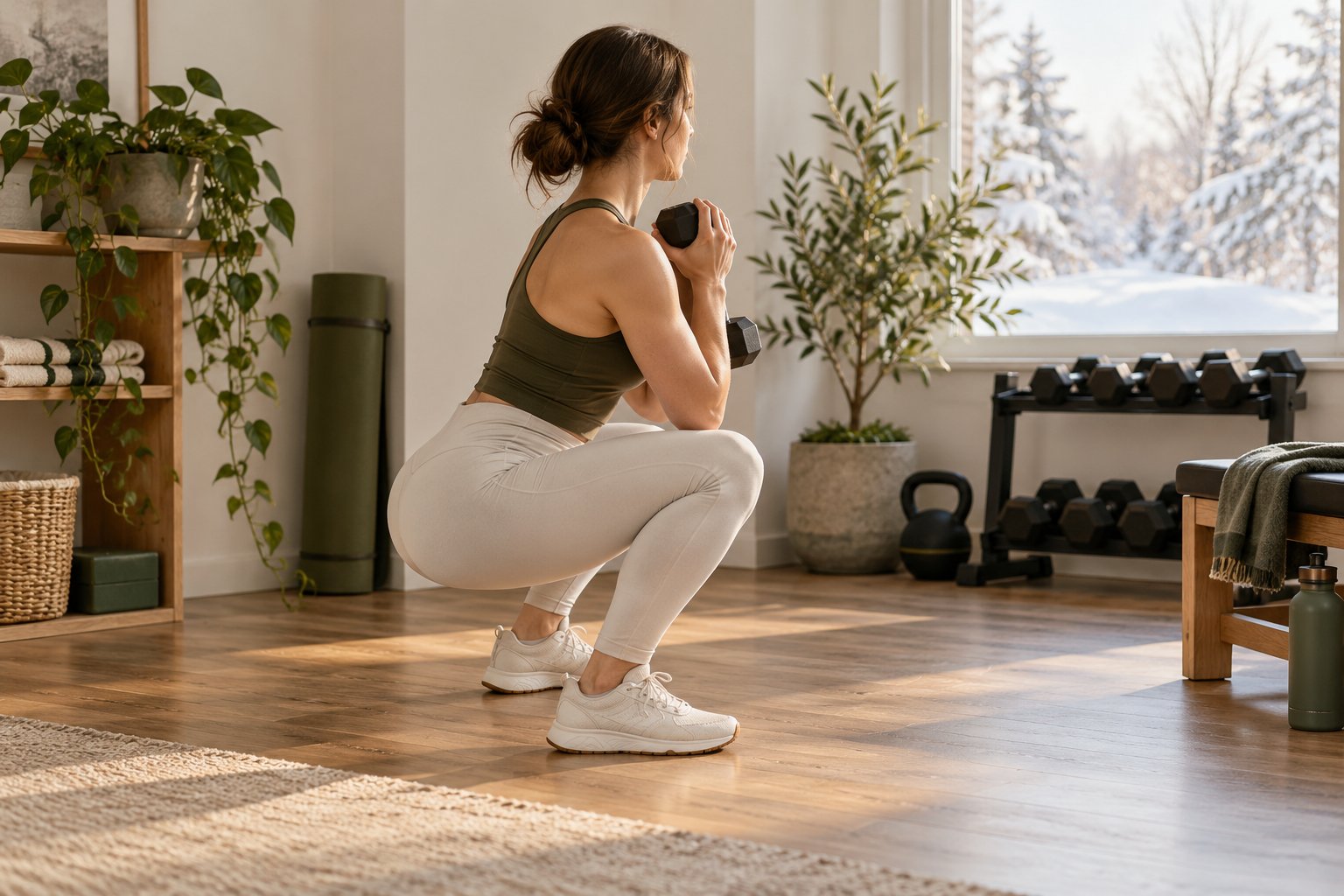
1. Goblet squat: 3 × 8–12
- Hold one dumbbell upright against your chest, elbows pointing down.
- Feet shoulder-width apart, push the hips back and bend the knees.
- Sit down between your heels with the chest up, then stand by pressing through the whole foot.
- Easier: squat to a chair with no weight.
- Harder: pause for two seconds at the bottom.
2. Romanian deadlift: 3 × 8–12
- Stand with a dumbbell in each hand in front of your thighs, knees soft.
- Push the hips back and slide the weights down your legs, keeping the back long and flat.
- Stop when you feel a stretch behind the thighs, usually around mid-shin, then stand by driving the hips forward.
- Easier: practise the movement with your hands on your hips and no weight.
- Harder: single-leg version with a hand on a wall.
3. Push-up or floor press: 3 × 6–12
- For the push-up: hands under the shoulders, body straight, lower the chest towards the floor and push back up.
- For the floor press: lie on your back with knees bent, a dumbbell in each hand above the chest, lower until the upper arms touch the floor, then press up.
- Easier: push-ups with hands on a kitchen counter.
- Harder: push-ups from the floor with a three-second lowering.
4. One-arm row: 3 × 8–12 each side
- Put one hand and knee on a sturdy bench or chair, the other foot on the floor.
- Let the dumbbell hang, then pull it towards your hip, elbow close to the body.
- Lower slowly without twisting the shoulders.
- Easier: a lighter weight, or a band row anchored in a door.
- Harder: pause for a second at the top.
5. Split squat: 2–3 × 8 each leg
- Stand in a long stride, back heel lifted.
- Lower the back knee straight down towards the floor, keeping weight on the front foot.
- Push back up and finish all reps before switching.
- Easier: hold a chair for balance, no weight.
- Harder: hold a dumbbell in each hand.
6. Suitcase carry: 3 × 30 seconds each side
- Hold one heavy dumbbell at your side like a suitcase.
- Walk slowly, standing tall without leaning towards the weight.
- Swap hands and repeat.
- Easier: a lighter weight and shorter walk.
- Harder: a heavier weight, or walk further.
A twice-a-week plan
Do the full session on two non-consecutive days, such as Monday and Thursday. Each session takes about 35–40 minutes including a warm-up.
| Week | Sets per move | Aim |
|---|---|---|
| 1–2 | 2 | Learn the moves, light weights |
| 3–6 | 3 | Add reps until you reach 12 |
| 7 onwards | 3 | Add weight, drop back to 8 reps, build up again |
Warm up with five minutes of marching or brisk walking and a few unloaded squats and hinges. If your hips feel stiff, our hip mobility routine works well before the squats.
How this fits with the rest of the week
The NHS recommends strengthening activities that work all the major muscles on at least two days a week, alongside 150 minutes of moderate activity such as brisk walking. Two sessions of this plan covers the first part. For the second, add walks or easy zone 2 cardio on the other days, and look after recovery with decent sleep and enough protein.
Questions people ask
Will lifting weights make me bulky?
Not on two sessions a week. Building large muscles takes years of heavy training and a lot of food. Most beginners find they look a little firmer and feel stronger.
How long until I see progress?
Most people lift more within two or three weeks, mainly because the nervous system learns the moves. Visible changes in muscle usually take a couple of months of steady training.
Dumbbells or a gym?
Either works. A pair of adjustable dumbbells or a single kettlebell is enough for the first year.
Photograph: AI-generated image