Wellness Origin Hub
A 20-minute bodyweight workout at home for beginners
A 20-minute bodyweight workout at home with no equipment: six beginner moves, clear sets and reps, and an easier and harder version of each.
You can build useful strength at home with no equipment and twenty minutes, two or three times a week. The workout below uses six basic moves that cover legs, hips, chest, back and core: a warm-up, two rounds of a circuit, and a short cool-down. Each move has an easier and a harder version, so the same plan works on day one and three months later.
All you need is a patch of floor, a sturdy chair or step, and ideally a mat.
The workout at a glance
| Part | What you do | Time |
|---|---|---|
| Warm-up | Marching, arm circles, hip hinges, easy squats | 4 minutes |
| Circuit | Six moves, 2 rounds, 60–90 seconds' rest between rounds | 13 minutes |
| Cool-down | Slow walking and three stretches | 3 minutes |
Warm-up (4 minutes)
- March on the spot, lifting the knees, for 1 minute.
- Big arm circles, forwards then backwards, for 30 seconds each way.
- Hip hinges: hands on hips, push the hips back with a long spine and stand up again, 10 times.
- Ten slow half squats, going only as deep as feels easy.
- Finish with 30 seconds of stepping side to side.
The circuit
Do each move in order, rest about 20 seconds between moves, and go through the whole circuit twice. Move slowly enough to stay in control: a rep should take two or three seconds.
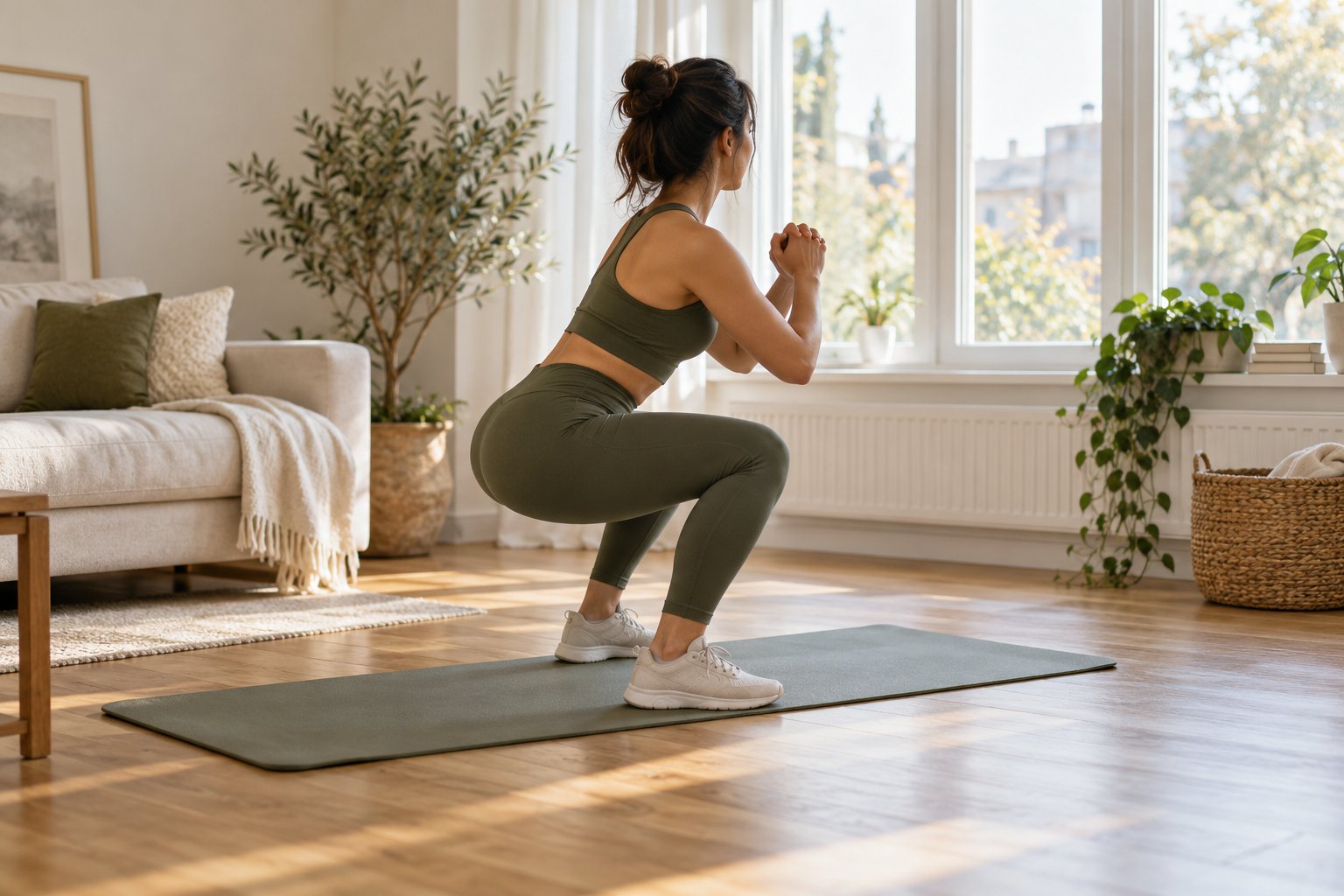
1. Squat: 10–12 reps
- Stand with feet about shoulder-width apart, toes turned out slightly.
- Push your hips back and bend your knees as if sitting into a chair, keeping your chest up.
- Go as low as you can with heels flat, then press through the whole foot to stand.
- Easier: squat to a chair, touch it lightly, and stand up.
- Harder: pause for 3 seconds at the bottom, or try split squats with one foot back.
2. Push-up: 6–10 reps
- Hands slightly wider than shoulders, body in a straight line from head to heels.
- Lower your chest towards the floor with elbows angled back at about 45 degrees.
- Push back up without letting the hips sag.
- Easier: hands on a kitchen counter or a sturdy table, or knees on the floor.
- Harder: slow the lowering to 3 seconds, or put your feet on a low step.
3. Glute bridge: 12–15 reps
- Lie on your back with knees bent and feet flat, hip-width apart.
- Squeeze your bottom and lift your hips until your body forms a line from shoulders to knees.
- Hold for a second at the top and lower slowly.
- Easier: smaller range, lifting the hips only halfway.
- Harder: single-leg bridge, 6–8 reps each side.
4. Reverse lunge: 6–8 reps each leg
- Stand tall, then step one foot back and lower the back knee towards the floor.
- Keep most of your weight on the front foot.
- Push through the front heel to return to standing, then switch legs.
- Easier: hold a chair back for balance and take a shorter step.
- Harder: pause just above the floor, or do all reps on one side before switching.
5. Table row or towel row: 8–10 reps
This is the pulling move most home workouts miss.
- Hold the edges of a sturdy table, lying underneath it with knees bent, or loop a towel round a closed, solid door handle and lean back holding both ends.
- Pull your chest towards the table or door, squeezing your shoulder blades together.
- Lower slowly.
- Easier: stand more upright so you lean back less.
- Harder: walk your feet further forward, or straighten your legs under the table.
Only use furniture that cannot tip or slide. If you have no safe option, swap in a resistance band row.
6. Plank: 20–40 seconds
- Forearms on the floor, elbows under shoulders, legs straight behind you.
- Brace your stomach as if about to be poked, and keep a straight line from head to heels.
- Breathe steadily throughout.
- Easier: knees on the floor, or forearms on a chair seat.
- Harder: lift one foot a few centimetres for a few seconds at a time, alternating.
Cool-down (3 minutes)
Walk slowly around the room for a minute, then hold each stretch for about 30 seconds a side: a standing quad stretch, a hamstring stretch with one heel on a low step, and a chest stretch with your forearm against a door frame.
How to progress
- Weeks 1–2: two sessions a week, easier versions where needed.
- Weeks 3–6: three sessions a week, with at least one rest day between them.
- After that: add a third round, or move to the harder versions one exercise at a time.
Mild muscle soreness for a day or two after the first few sessions is normal. If it is bad enough to change how you walk, do less next time.
Pair this with some easy cardio such as a beginner walking plan or run-walk intervals, and you cover the basics most health bodies recommend: the NHS suggests adults do strengthening activities on at least two days a week, alongside 150 minutes of moderate activity.
Questions people ask
Can you build muscle with bodyweight exercise?
Yes, especially as a beginner. Muscles respond to effort, so taking sets close to the point where the last rep is hard matters more than whether the resistance is a dumbbell or your body.
Is 20 minutes enough?
Two or three sessions of twenty minutes a week is a solid start and far better than an ambitious plan you stop after a fortnight.
Should I do it every day?
Not this workout. Muscles need time to recover, so leave a day between sessions and walk or stretch on the days in between.
Photograph: AI-generated image