Wellness Origin Hub
Yoga for beginners: eight poses and a 15-minute first routine
Yoga for beginners made simple: eight basic poses explained step by step, how long to hold each, and a calm 15-minute routine to try at home.
Yoga for beginners starts with a handful of poses held gently while you breathe slowly through the nose. You do not need to be flexible, and you do not need a class to begin. The eight poses below cover the basic shapes most classes are built from, and together they make a quiet fifteen-minute routine you can do at home on a mat or carpet.
Go slowly, stay well away from pain, and treat each pose as something to explore rather than a position to force.
Before you start
- A mat helps. It stops hands and feet slipping. Our guide to yoga mats for home covers the options.
- Wear something you can move in. Bare feet grip better than socks.
- Breathe through the nose. Slow, even breaths, a little longer on the out-breath. If you start holding your breath, ease off.
- Use props. A cushion, a folded blanket or a stack of books in place of a block makes most poses easier.
The eight poses
1. Mountain pose (tadasana): 5 breaths
- Stand with feet hip-width apart, weight even across both feet.
- Let the arms hang, lengthen up through the crown of the head and relax the shoulders.
- Breathe slowly and notice the feet on the floor.
- Easier: stand with your back lightly against a wall.
- Harder: close your eyes, or raise the arms overhead.
2. Cat-cow: 6–8 slow rounds
- Kneel on all fours, hands under shoulders and knees under hips.
- Breathe in and let the stomach drop, lifting the chest and tailbone (cow).
- Breathe out and round the back, tucking the chin and tailbone (cat).
- Easier: make the movement smaller, or do it seated on a chair.
- Harder: add slow circles of the hips between rounds.
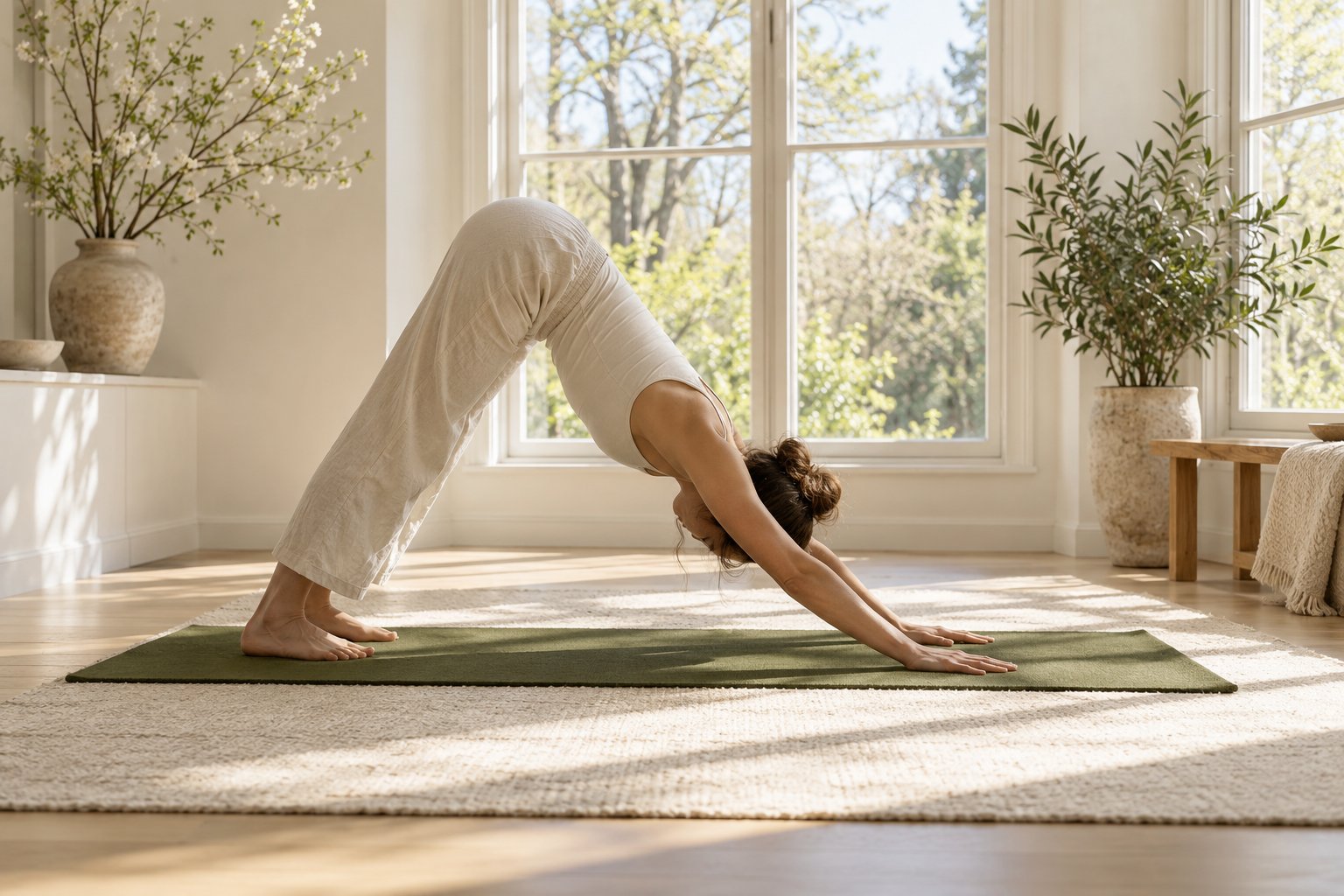
3. Downward-facing dog: 5 breaths
- From all fours, tuck your toes and lift your hips up and back.
- Press the floor away with your hands and lengthen the spine.
- Keep the knees bent as much as you need to keep the back long.
- Easier: hands on a chair seat or table edge instead of the floor.
- Harder: straighten the legs and lower the heels towards the floor.
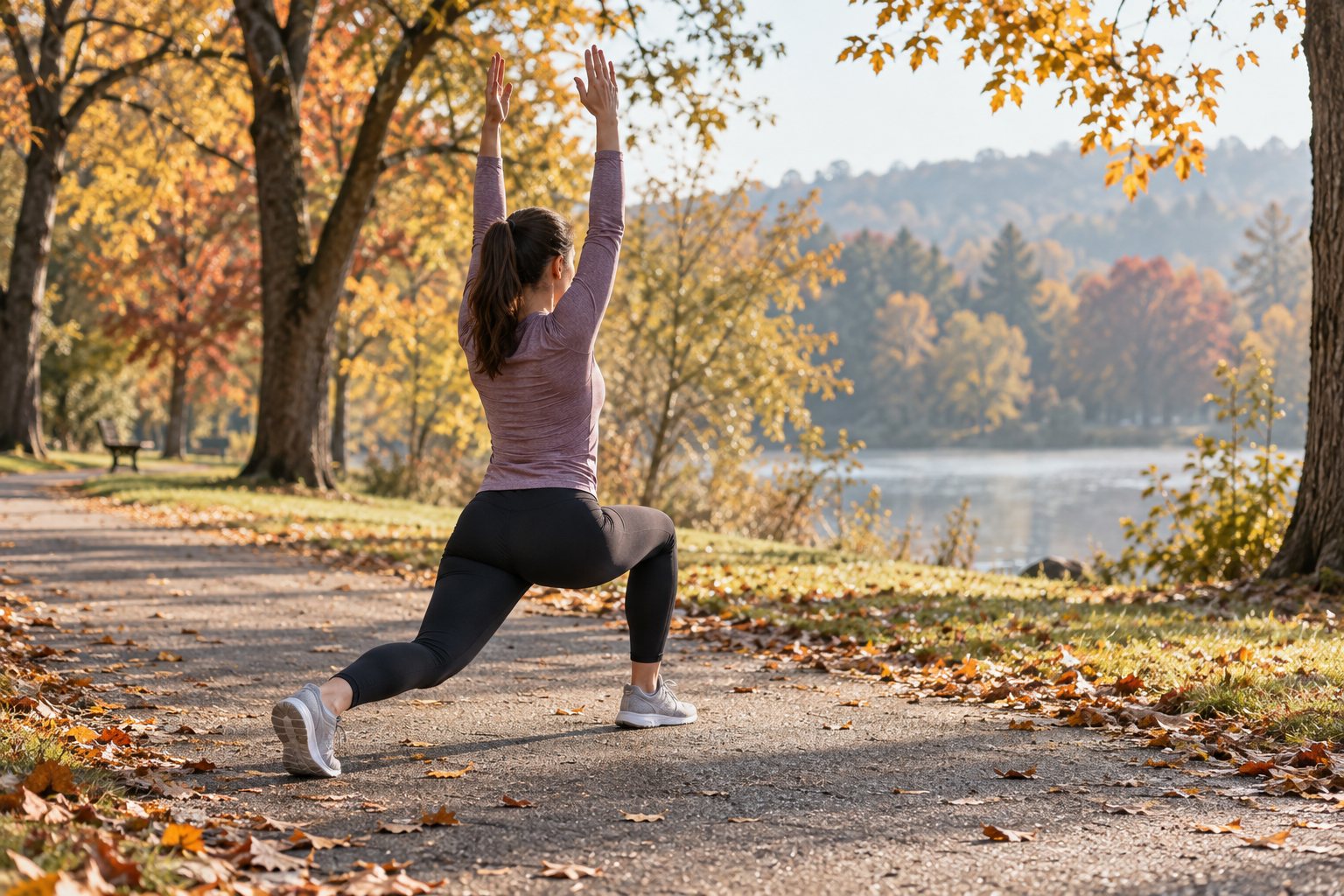
4. Low lunge: 5 breaths each side
- Step the right foot forward between the hands and lower the left knee to the floor.
- Move the hips forward gently until you feel a stretch at the front of the left hip.
- Keep the front knee above the ankle, then switch sides.
- Easier: put a folded blanket under the back knee and hands on the front thigh.
- Harder: lift the arms overhead.
5. Warrior II: 5 breaths each side
- Stand with feet wide apart, right toes pointing forward to the short end of the mat, left foot turned in slightly.
- Bend the right knee over the right ankle and reach the arms out at shoulder height.
- Look past the front hand, then switch sides.
- Easier: a shorter stance and less bend in the front knee.
- Harder: a deeper knee bend and a longer hold.
6. Tree pose: 5 breaths each side
- Stand on the left foot and place the right sole on the inside of the left ankle, calf or thigh, never on the knee.
- Bring the hands together at the chest and fix your gaze on one point.
- Switch sides.
- Easier: keep the toes of the lifted foot on the floor, or touch a wall.
- Harder: raise the arms overhead.
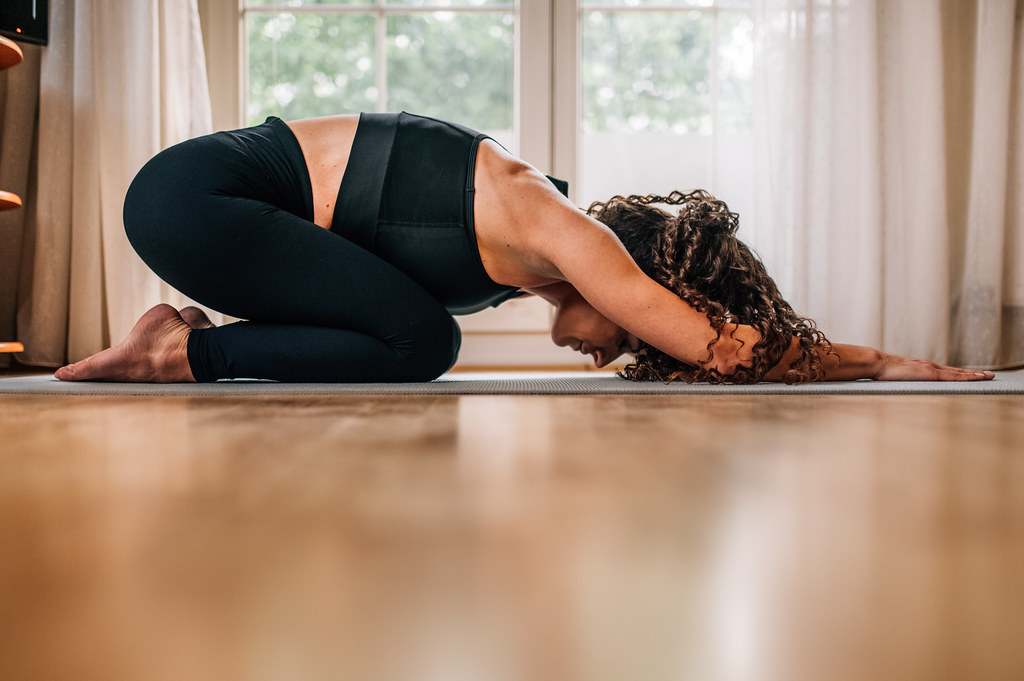
7. Child's pose: 8–10 breaths
- Kneel, big toes together and knees apart.
- Sit back towards the heels and fold forward, arms stretched ahead or by your sides.
- Rest the forehead on the floor or a cushion.
- Easier: put a cushion between the heels and bottom, or under the chest.
- Harder: walk the hands to one side for a gentle side stretch.
8. Reclined twist: 5 breaths each side
- Lie on your back and hug the knees in.
- Let both knees fall slowly to the right, arms out wide, shoulders on the floor.
- Return to the centre and switch sides.
- Easier: put a cushion under the knees.
- Harder: straighten the top leg slightly.
A 15-minute first routine
| Order | Pose | Time |
|---|---|---|
| 1 | Mountain pose | 1 minute |
| 2 | Cat-cow | 2 minutes |
| 3 | Downward dog | 1 minute |
| 4 | Low lunge | 2 minutes |
| 5 | Warrior II | 2 minutes |
| 6 | Tree pose | 2 minutes |
| 7 | Child's pose | 2 minutes |
| 8 | Reclined twist, then lie still | 3 minutes |
Finish by lying flat on your back for a minute or two with your eyes closed. That final rest is part of the practice, not an extra.
If evenings suit you best, the twist and child's pose fit neatly into an evening wind-down routine. For tight hips from running or sitting, add our hip mobility routine, and finish with a few slow breaths.
Questions people ask
Do I need to be flexible to do yoga?
No. Flexibility comes from practice, not before it. Bend the knees, use props and keep each stretch mild.
How often should a beginner practise?
Two or three times a week is a good start. Many people find a few minutes most days easier to keep than one long session.
Is yoga enough exercise on its own?
Gentle yoga helps flexibility, balance and relaxation, but most health bodies also recommend regular moderate cardio and strength work. It pairs well with walking and a simple strength plan.
Photograph: AI-generated image