Wellness Origin Hub
How to build habits that last: start tiny and make it easy
How to build habits that last: start with a tiny version, attach it to something you already do, and make it easy to begin. A practical method with examples.
To build a habit that lasts, make it so small you cannot fail, attach it to something you already do every day, and remove whatever makes it awkward to start. Motivation fades within a few weeks; a habit survives because it has become the easy, automatic thing to do in a particular moment. Repetition in the same situation is what builds that.
That is why big new-year plans tend to collapse by February, and tiny ones often do not.
How habits form
A habit is a behaviour that has become linked to a cue, such as a time, a place or something you have just done. After enough repetitions, the cue starts the behaviour with little thought.
A well-known study from University College London followed people building a new daily habit, such as drinking water with lunch. On average it took around two months for the behaviour to feel automatic, with a very wide range between people and habits. Missing the odd day did not make much difference. The lesson: expect weeks, not days, and do not abandon the plan after one slip.
The method in four steps
| Step | What to do | Example |
|---|---|---|
| 1. Start tiny | Pick a version that takes under two minutes | Put on running shoes and step outside |
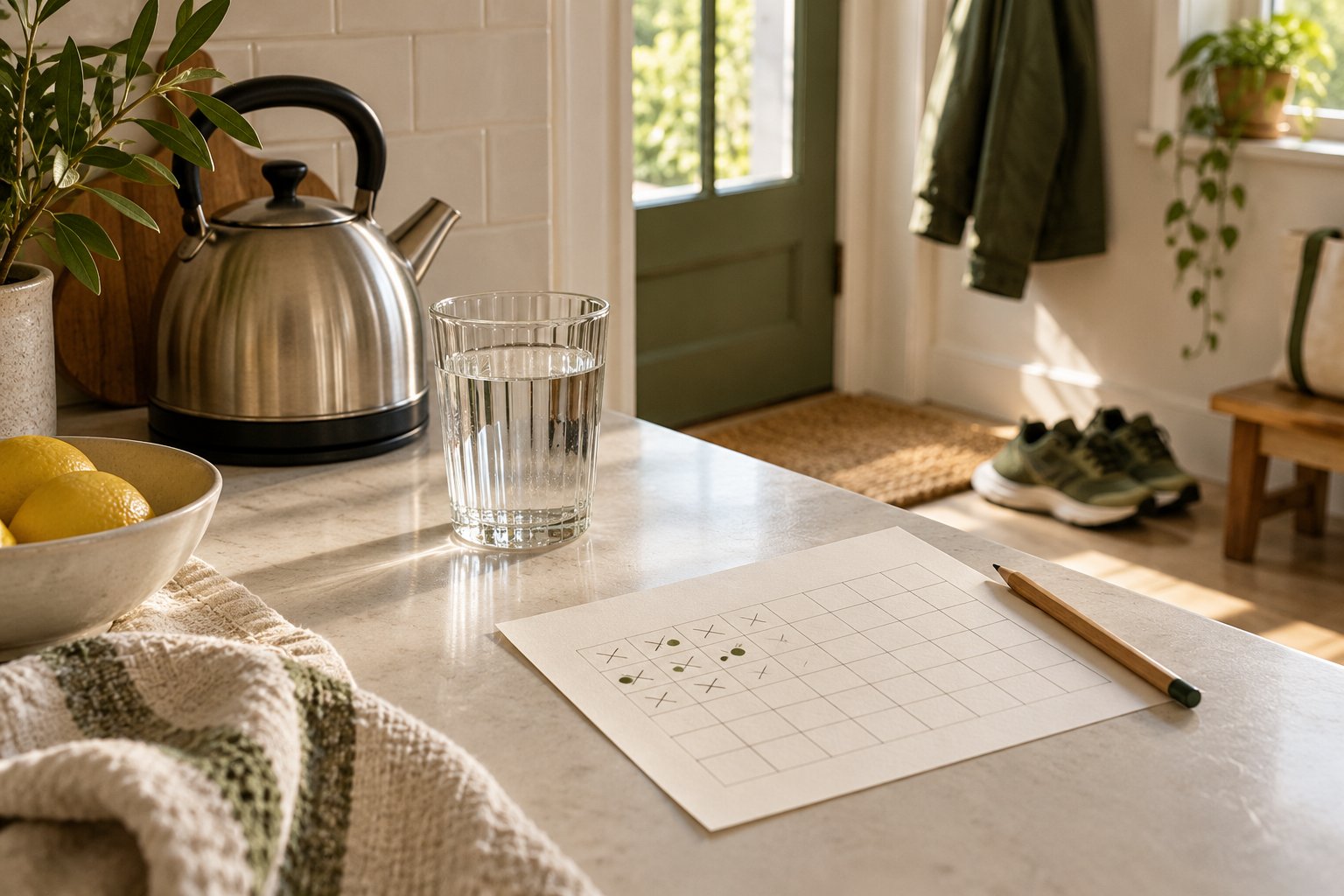
| 2. Attach it | Link it to an existing daily cue | After I switch on the kettle, I drink a glass of water |
| 3. Make it easy | Remove friction, prepare in advance | Leave the glass by the kettle |
| 4. Track and repeat | Mark it off, restart quickly after misses | A tick on a paper tracker |
1. Start tiny
Choose a version of the habit so small it feels almost silly. Two push-ups. One page of a book. One line in a journal. Put on your trainers and walk to the end of the road.
The point is to make the habit happen every day, even on the worst days. Once it is automatic, it is easy to do more; many days you will naturally carry on past the minimum. But the minimum is what counts.
2. Attach it to an existing routine
Pick a cue you already do every day without fail, and place the new habit straight after it. A simple sentence helps: "After I [current habit], I will [new habit]."
- After I pour my morning coffee, I will write down one priority.
- After I brush my teeth at night, I will put my phone on the charger in the hall.
- After I sit down on the train, I will read one page.
The more specific the cue, the better. "In the morning" is vague; "after I switch on the kettle" is not. Our simple morning routine is built entirely on this kind of chain.
3. Make it easy to start
Most habits fail at the first step, not the middle. Look at what stands between you and starting, and remove it.
- Lay out exercise clothes the night before.
- Keep a book on your pillow, not on a shelf.
- Put fruit at eye level in the fridge and biscuits on a high shelf.
- Delete an app from your phone's home screen to make scrolling slightly harder.
Making a bad habit harder works the same way in reverse. Distance and a few extra steps are surprisingly powerful.
4. Track it, and restart fast
A paper tracker on the fridge, with a tick for each day, gives a small sense of progress that apps rarely match.
Choosing the right habit
Start with one. Pick the habit that would make other things easier, often sleep, movement or planning, rather than the one you feel most guilty about.
- Health: a ten-minute walk after lunch, or a glass of water before coffee.
- Movement: five minutes of stretching after you get up; see our stretches for desk workers.
- Mind: two minutes of journaling before bed.
- Reading: a page a day, as in our guide to building a reading habit.
Add a second habit only once the first runs on its own, usually after a few weeks.
Why habits break, and what to do
- The habit is too big. Shrink it until you can do it on a bad day.
- The cue is vague. Tie it to a specific action, not a time of day.
- Your routine changed. Holidays, new jobs and illness break cues. Pick a new one and restart with the tiny version.
- You are relying on willpower. Change the surroundings instead: put the thing you want to do in plain sight.
- All or nothing thinking. A two-minute version still counts.
Questions people ask
How long does it take to build a habit?
It varies a lot between people and habits. Research suggests around two months on average for a daily habit to feel automatic, and simple habits can be quicker.
Is it better to do habits in the morning?
Only if your mornings are predictable. The best time is the one with a reliable cue you hit every day.
Should I reward myself?
Small, immediate rewards can help early on: a tick on the tracker, or doing the habit with a favourite drink. Over time the habit itself usually becomes the reward.
Photograph: AI-generated image