Wellness Origin Hub
Balance exercises you can do at home, at any age
Seven balance exercises you can do at home beside a kitchen counter, from a supported one-leg stand to heel-to-toe walking, with timings and easier and harder versions.
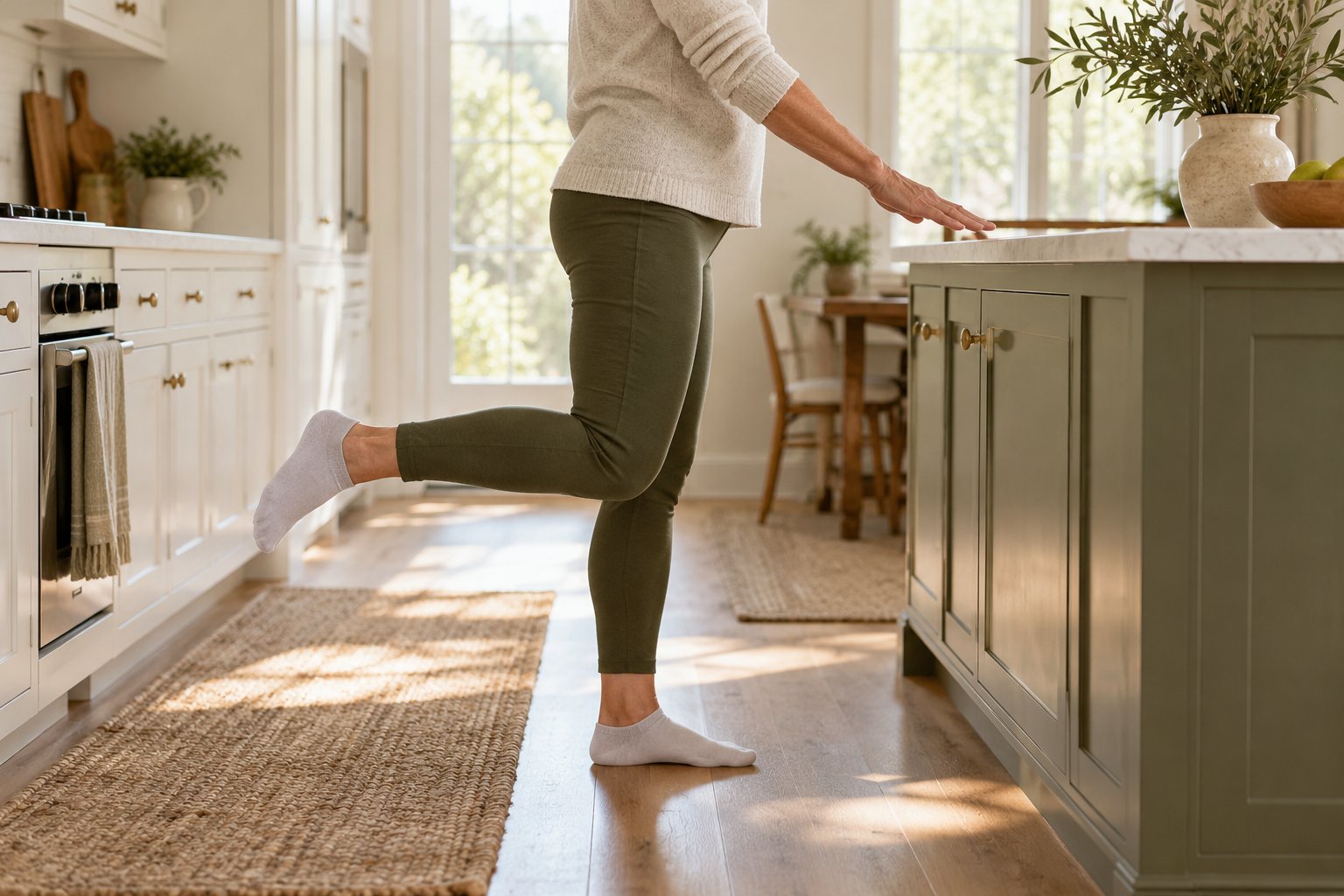
Balance exercises train the body to stay steady when the ground shifts, a foot catches or you turn quickly, and they can be done at home in ten minutes beside a kitchen counter. Balance is a skill as much as a strength, so it improves with regular practice at any age. The seven moves below start with support and gradually take it away.
Keep a sturdy counter or the back of a heavy chair within reach for every exercise, and stand in socks with grip or bare feet on a non-slip floor.
Why balance is worth training
Balance relies on the eyes, the inner ear, sensors in the feet and joints, and the strength of the legs and hips. All of these tend to get less sharp with age and with sitting a lot, which is one reason falls become more common later in life. Research suggests that regular balance and strength training can lower the risk of falls in older adults.
The NHS recommends that adults aged 65 and over do activities that improve strength, balance and flexibility on at least two days a week. Younger people benefit too: good balance helps with running, sport, carrying children and walking on ice.
The routine at a glance
| Exercise | Time or reps | Sets |
|---|---|---|
| Weight shifts | 10 each side | 1 |
| Feet together stand | 30 seconds | 2 |
| Heel-to-toe stand | 20–30 seconds each foot forward | 2 |
| One-leg stand | 10–30 seconds each leg | 2 |
| Heel-to-toe walk | 10–15 steps | 2 |
| Sit to stand | 8–10 reps | 2 |
| Heel and toe raises | 10 of each | 2 |
The whole routine takes about ten minutes. Do it three or more days a week.
The exercises
1. Weight shifts: 10 each side
- Stand with feet hip-width apart, hands resting on the counter.
- Shift your weight slowly onto the right foot until the left foot feels light, without lifting it.
- Hold for two seconds, then shift to the left.
- Easier: smaller shifts with both hands on the counter.
- Harder: shift forwards and backwards too, or let go of the counter.
2. Feet together stand: 2 × 30 seconds
- Stand with your feet touching, hands hovering just above the counter.
- Look ahead at a fixed point and breathe normally.
- Touch the counter whenever you need to.
- Easier: feet slightly apart, fingertips on the counter.
- Harder: turn your head slowly side to side, or close your eyes with both hands near the counter.
3. Heel-to-toe stand: 2 × 20–30 seconds each side
- Place one foot directly in front of the other, heel touching toes, as if on a tightrope.
- Hold the counter lightly at first, then hover the hand above it.
- Swap which foot is in front.
- Easier: leave a small gap between the feet, slightly staggered.
- Harder: hold for longer, or look up at the ceiling.
4. One-leg stand: 2 × 10–30 seconds each leg
- Stand side-on to the counter with one hand above it.
- Lift one foot a few centimetres off the floor, keeping the hips level.
- Hold, then switch legs.
- Easier: rest the toes of the lifted foot on the floor, or keep a hand on the counter.
- Harder: stand on a folded towel or cushion, or swing the lifted leg slowly forwards and back.
5. Heel-to-toe walk: 2 × 10–15 steps
- Walk along the counter, placing the heel of each foot just in front of the toes of the other.
- Keep your eyes ahead, not on your feet.
- Turn carefully and walk back.
- Easier: take normal-width steps along a line, with a hand on the counter.
- Harder: walk backwards the same way, close to the counter.
6. Sit to stand: 2 × 8–10
- Sit near the front of a sturdy chair, feet flat and hip-width apart.
- Lean forward slightly and stand up without using your hands if you can.
- Sit down slowly and with control.
- Easier: use your hands on the armrests, or a higher seat.
- Harder: cross the arms over the chest, or lower more slowly.
7. Heel and toe raises: 2 × 10 each
- Hold the counter and rise slowly onto your toes, then lower.
- Then rock back onto your heels, lifting the toes, and lower.
- Easier: smaller movements with both hands on the counter.
- Harder: single-leg heel raises.
How to progress
Move to the harder version of one exercise at a time, once you can hold the current one steadily for the full time on two days in a row. Reduce support in stages: two hands, one hand, fingertips, a hovering hand, then none.
Strong legs and hips help balance as much as practice does, so pair this with simple strength work such as sit to stands and squats and regular walks. Gentle yoga, especially tree pose, adds variety. If your hips feel stiff, try our hip mobility routine.
Questions people ask
How long does it take to improve balance?
Many people notice a difference within a few weeks of practising three times a week. Like any skill, it fades if you stop.
Should I close my eyes?
Only once the eyes-open version feels easy, and only with a hand right next to support. Removing vision makes balance much harder.
What if I am worried about falling?
Ask a doctor or physiotherapist for a balance assessment. Many areas also run falls-prevention or strength and balance classes, often through local health services.
Photograph: AI-generated image