Wellness Origin Hub
Sujeonggwa, Korean cinnamon and ginger punch with persimmon
How to make sujeonggwa, the Korean cinnamon ginger punch served cold after festive meals, with dried persimmon softened in the spiced syrup and a few pine nuts on top.
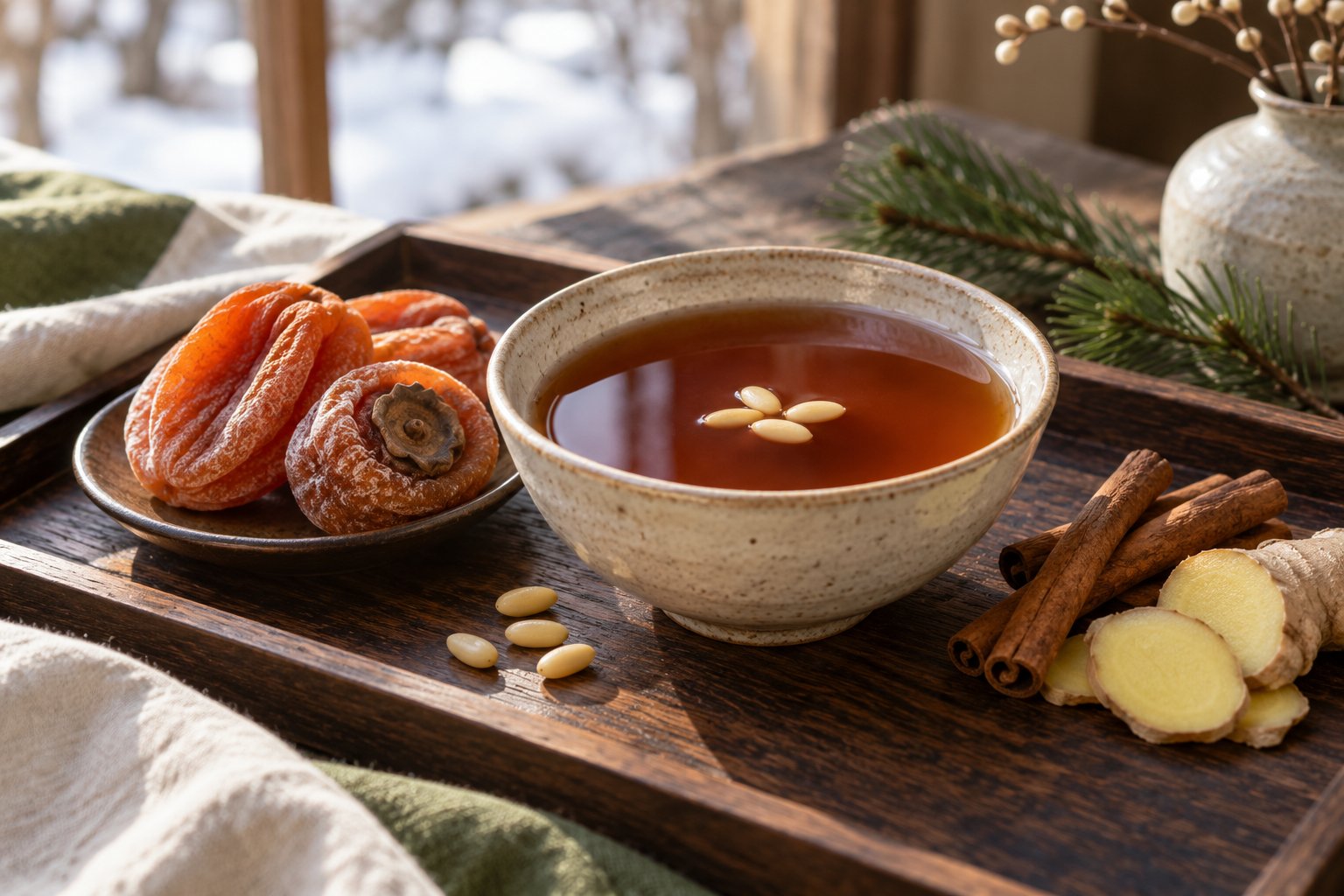
Sujeonggwa is a Korean punch made by simmering cinnamon and ginger in water, sweetening the liquid with brown sugar and chilling it with dried persimmons that soften into the syrup overnight. It is served cold in small bowls with a few pine nuts floating on top. The taste is warm and spicy, sweet but clean, with the persimmon adding a soft, jammy fruit to eat with a spoon.
It is one of Korea's traditional drinks, or eumcheongnyu, and has been served for centuries. Today it appears most often at Seollal, the Lunar New Year, at Chuseok and at the end of large meals, when its cinnamon and ginger are thought of as a pleasant way to settle the stomach. Bottled and canned versions are sold in Korean shops all year, but homemade sujeonggwa is less sweet and much more fragrant.
How to make it
- Rinse the cinnamon sticks briefly to remove any dust.
- Put the ginger in one saucepan with 1 litre of the water, and the cinnamon in a second saucepan with the other litre.
- Bring both to the boil, then lower the heat and simmer for about 30 minutes, until each liquid is strongly flavoured.
- Strain both liquids and mix them in one pan. Discard the ginger and cinnamon.
- Add the sugar and stir over a low heat until it dissolves. Taste: it should be sweet and spicy, a little stronger than you want to drink it, as it softens when chilled.
- Leave to cool completely, then pour into a jar or jug and add the dried persimmons.
- Chill overnight, or for at least 6 hours, until the persimmons are soft.
- Serve cold in small bowls or cups, one persimmon each, with a few pine nuts on top.
Why the spices are boiled separately
Most Korean recipes simmer the ginger and cinnamon in separate pots. Cinnamon gives the drink its red-brown colour and sweet perfume; ginger gives the heat. Boiled together for a long time, the two can turn cloudy and slightly bitter, and the cinnamon loses some of its scent. Two pans mean a little more washing up and a clearer, brighter punch. If you are short of time, one pan works: add the cinnamon for the last 20 minutes only.
Choosing the ingredients
| Ingredient | What to look for | Swap if you cannot find it |
|---|---|---|
| Cinnamon | Thick cassia sticks, the usual choice in Korea, for a strong, spicy flavour | Ceylon cinnamon gives a milder, more floral drink; use a third more |
| Ginger | Firm and fresh with tight skin | No good swap; ground ginger clouds the punch |
| Dried persimmon | Soft, flattened gotgam from a Korean grocer | Dried figs or dried apricots, which soften the same way |
| Pine nuts | Fresh, pale and sweet-smelling | Leave out, or use a few toasted flaked almonds |
| Sugar | Light brown sugar for colour and a caramel note | White sugar plus a spoon of honey |
Tips for the best flavour
- Slice the ginger thinly. Thin slices give up their flavour quickly in 30 minutes. Thick chunks need longer and give less.
- Sweeten to taste. Traditional sujeonggwa is quite sweet. Start with 80 g of sugar for two litres and add more after tasting the cooled liquid.
- Do not add the persimmons hot. Hot liquid makes them fall apart. Cool liquid lets them soften slowly and keep their shape.
- Serve it very cold. Sujeonggwa tastes sharper and more refreshing straight from the fridge, the way it is offered after a heavy meal.
Variations
- Jujube: add three or four dried jujubes (Korean red dates) to the ginger pan for a rounder, sweeter taste.
- Warm: gently reheat a cup on cold days. It is not traditional, but it is very comforting.
- Less sweet: use half the sugar and add a little honey to each bowl when serving.
- With other spices: a few black peppercorns, added to the cinnamon pan, give a subtle extra warmth, as in some family recipes.
Make ahead and storage
Use the buttons beside the ingredients to make a larger batch for a holiday table. Sujeonggwa keeps in a covered jar in the fridge for about a week. The persimmons keep softening, so add them a day before serving if you are making it well ahead. Float the pine nuts only when you serve, or they go soft.
Questions people ask
What does sujeonggwa taste like?
Like a cold, sweet cinnamon tea with a gentle ginger heat. The persimmon tastes of honeyed dried fruit and turns tender and slightly chewy. It is closer to a light spiced syrup than a juice.
Is sujeonggwa the same as sikhye?
No. Both are traditional Korean festive drinks served cold, but sikhye is a sweet rice drink made with malted barley, pale and mild, with grains of rice floating in it. Sujeonggwa is a dark, spiced cinnamon and ginger punch.
Does sujeonggwa contain caffeine?
No. It is made only from spices, sugar and fruit, so it is caffeine-free. For another caffeine-free Korean drink to keep in the fridge, try Korean barley tea.
If you like warm spice in a cup, you may also enjoy our masala chai or the slow-simmered hot spiced apple cider.
Photograph: AI-generated image