Wellness Origin Hub
Fresh lemongrass and ginger tea, brewed the Southeast Asian way
How to make fresh lemongrass ginger tea at home: bruised lemongrass stalks and sliced ginger simmered for ten minutes, as it is brewed in kitchens across Southeast Asia.
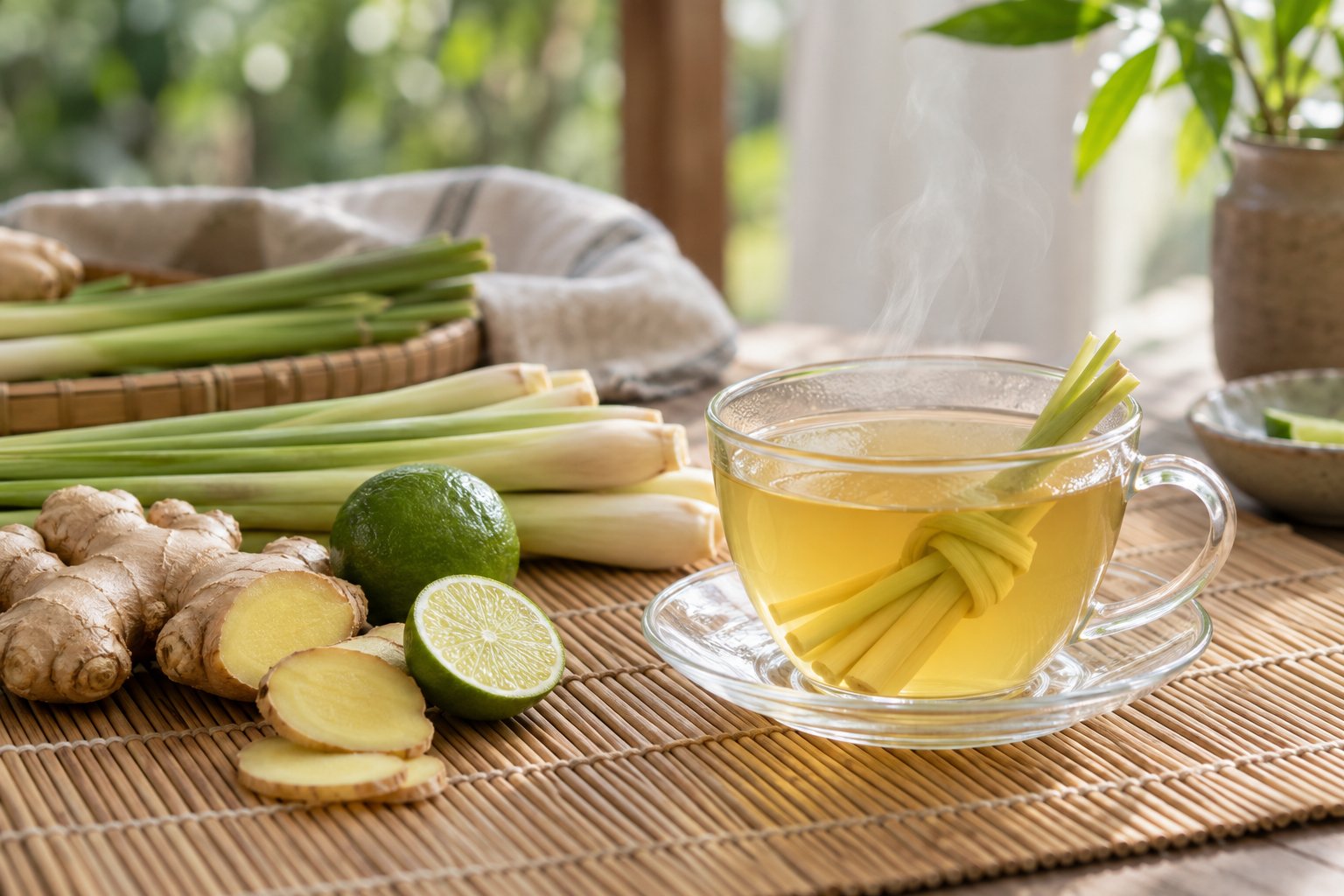
Lemongrass ginger tea is fresh lemongrass stalks, bruised to release their oils, simmered with sliced ginger for about ten minutes and strained. It is pale gold, smells of lemon peel and fresh grass, and has a gentle warmth from the ginger. It has no caffeine and needs nothing more than a small pan.
Across Southeast Asia, versions of this drink are made at home rather than bought. In Vietnam it is trà sả gừng. In Thailand, nam takrai (lemongrass water) is sold chilled and sweetened as well as drunk hot. In Indonesia and Malaysia, warm ginger and lemongrass drinks such as wedang serai are a common evening drink. Each family has its own balance, and there is no fixed recipe.
How to make it
- Trim the root end and the dry tops from the lemongrass and peel off the tough outer layer.
- Bash each stalk along its length with the back of a knife or a rolling pin until it splits, then cut it into 5 cm pieces or tie it in a loose knot.
- Put the lemongrass, ginger and water in a small pan and bring to the boil.
- Turn the heat down and simmer gently for 10 minutes, with the lid on so the fragrance stays in the pan.
- Take it off the heat and leave it to stand for 5 minutes.
- Strain into cups, stir in honey or palm sugar if you like, and serve with a wedge of lime.
Buying and preparing lemongrass
Fresh lemongrass is sold in Asian grocers and many supermarkets, usually in bundles of three or four stalks. Look for firm, heavy stalks with a pale lower end and green, not brown, tops. The flavour is in the lower two-thirds; the dry upper leaves have little taste.
| Form | How to use it | Flavour |
|---|---|---|
| Fresh stalks | Bruise, cut and simmer | Bright and lemony, the best choice |
| Frozen stalks | Use straight from the freezer | Almost as good as fresh |
| Dried, cut lemongrass | 1 tablespoon per cup, steep 5 to 7 minutes | Milder and more like hay |
| Lemongrass paste in a tube | Not recommended for tea | Often contains oil and salt |
Bruising matters more than anything else. Lemongrass is fibrous, and an unbruised stalk simmered whole gives a weak tea. Splitting it lets the water reach the oils inside.
Tips for the best flavour
- Do not boil it hard. A gentle simmer keeps the lemon fragrance; a rolling boil drives it off and leaves a grassy, flat taste.
- Slice the ginger thinly. Thin coins give their flavour in ten minutes; thick chunks need longer.
- Add lime at the end. Lime juice simmered in the pan turns bitter.
- Sweeten lightly, if at all. Palm sugar gives a soft caramel note that suits the lemongrass well.
Variations
- Pandan: add a knotted pandan leaf to the pan, as is common in Thailand and Malaysia. It adds a soft, vanilla-like scent.
- Iced: make it double strength, sweeten while hot, then pour over plenty of ice with lime. This is close to the chilled nam takrai sold in Thailand.
- With green tea: steep a teaspoon of green tea in the strained, slightly cooled tea for 2 minutes.
- Stronger ginger: grate half the ginger instead of slicing it. For a cold, sharp ginger drink, see our ginger lemon tonic.
- Spiced: a cinnamon stick or two cloves turn it into a warming winter tea. For a milky spiced option, try our masala chai.
Make ahead and storage
Brew a larger pan, strain it and keep it covered in the fridge for up to three days. Reheat gently or drink it cold. Fresh lemongrass keeps for about two weeks wrapped in a damp cloth in the fridge, or for months chopped and frozen in a bag.
Questions people ask
Is lemongrass ginger tea good before bed?
It has no caffeine, which makes it a sensible warm drink for the evening. It will not put you to sleep, but a calm, warm drink can be a useful part of an evening wind-down routine.
Does lemongrass tea have health benefits?
Lemongrass is used in traditional medicine in many countries, and laboratory studies have looked at compounds in its oil. There is little good research in people, so it is best enjoyed as a pleasant, caffeine-free drink rather than a remedy. Ginger has a little more evidence: some studies suggest it may help with mild nausea.
Can I reuse the lemongrass?
You can simmer it a second time, but the tea will be much weaker. Fresh stalks for each batch give a better flavour.
Photograph: AI-generated image